
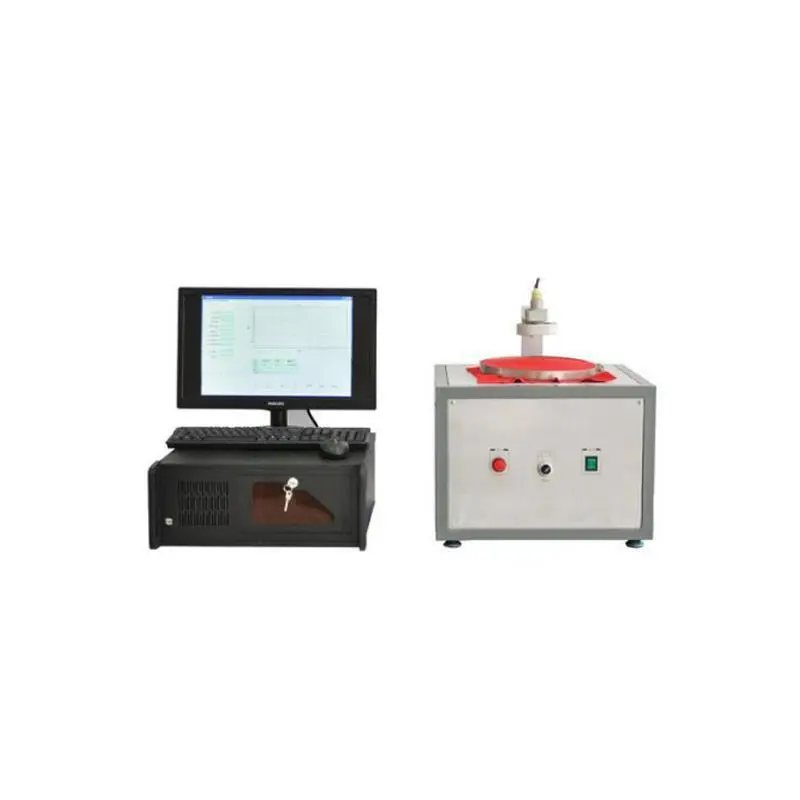
Protective clothing Electrostatic Charge Attenuation Tester GT-RC10
Electrostatic Charge Attenuation Tester
Product Description
The Electrostatic Charge Attenuation Tester uses the induction effect of step voltage to charge the test specimen, and measure the half-life and shielding coefficient of the specimen in a non-contact state.
Electrostatic Charge Attenuation Tester Standards:
T/CNTAC62, EN 1149
Product Specifications
Our specialists can help you find the perfect Electrostatic Attenuation Tester for you.
| Model | GT-RC10 |
| Step Voltage Generator | Outputs a step voltage of (1200±50) V |
| Decay Time | Adjustable range of 0–180 seconds, with an error of ±0.01 seconds. |
| Signal Acquisition Sensor | A metal disc with φ(30±1) mm, surrounded by a grounded protection ring; the probe is connected to an amplifier. The distance between the sensor surface and the top of the support ring is (50±1) mm |
| Electrode | A stainless steel disc with a diameter of φ(70±1) mm, fixed on an insulating bracket |
| Support Ring | A metal ring with an inner diameter of φ(100±1) mm; the distance between the top of the support ring and the electrode surface is (4.0±1) mm, coaxial with the electrode |
| Specimen Clamping Ring | Composed of an inner ring and an outer ring, with the specimen placed between them. The outer diameter of the inner ring is (250±1) mm, and the inner diameter is (220±1) mm, grounded and coaxial with the electrode and support ring. The outer ring is made of elastic (bendable) material for easy specimen clamping |
| Decay Ratio | Adjustable range of 0.1%–100%. |
| Seat Construction | 300 mm × 300 mm |
| Power Supply | AC220V; 50Hz |
Products Advantages
Voltage Application Device: Capable of generating a step voltage of (1200±50) V within 30 μs.
Signal Acquisition Sensor: Addresses zero drift and external interference in electrostatic potential, optimizes signal processing, and improves detection accuracy.
Computer Control: Real-time display of voltage-time curves, voltage half-life, and shielding coefficient of the specimen; data storage, historical data query, and curve printing functions.
Quick links
Products